At 16 years of age, after being ridden for 12 years I quit riding him. I had a nicer horse. I had also changed riding instructors. Thank goodness. It wasn't that she was tough but that she didn't give me the information I needed in order to ride my horse better so that he didn't pull (actually it was me holding him so he pulled) and run through the bit. My new instructor "rode the horse while I sat on my horse". It was amazing. Suddenly I wasn't being told to lower my hands, to shorten my reins but actually almost the opposite. My back is long, my arms normal length so naturally I couldn't ride with my hands just above the withers. As a female it was also impossible for me to ride with my hands 6 inches apart (for a male that is in front of the hips). The longer rein stopped the horse from running through the bit. It allowed her to drop her neck and reach for the bit.
Martina's lessons were simple. No complicated movements to try to do. Just 20 metre circle, go large, turn. However, one had to feel what the horse was doing and ask at the correct time. Much easier to ride. Either the horse responded or not. No upcoming turns or inclines to worry about. Correction of the horse and rider were consistent. Focus on the rider enabled the horse to relax and move better.
I still remember my first lesson. flex to the inside, inside leg, half halt with outside rein. And suddenly the horse was bent to the inside, paying attention, easier to ride, and so on and so on. this lesson was the night before Martina was flying to Germany for the winter. It took me almost all winter to learn when and where to use this (everywhere).
Circles were easy doing it Martina's way. Turn you upper body the degree you want the horse to turn. More for 10 metre circles less for 20 metre circles. No half halts. No bending to the inside. Look to where going and turn your upper body. Piece of cake.
Another lesson I remember was also just before going off to Germany was to correct my pulling/heavy hands. It was loosen the reins to almost the bucket. (almost 12" from the buckle). Spring had a beautiful neck so over bent to loosen the contact of my hands. I was to do this until Martina returned. Three months on a loose rein. It wasn't a hardship. I could walk, trot, canter, turn etc etc. I just could not shorten my reins. Oh my goodness the difference this time made. Spring reached for the contact and never over bent after this. She was a delight to ride. Nice before but a delight now.
In addition to having simpler easy to replicate lessons I was learning to reward my horse. Uberstretchen is a reward for the horse. One rein or both reins it is a reward. It is also a test to see if your horse is on the outside rein. If not when you give with the inside rein the horse will counter bend to the outside.
Feeding after work is a reward for horses. The last thing they remember of you is eating. This means the next day when you go to get your horse the horse comes to you. That is not a hardship.
Treats during work help the horse understand that this is what is wanted. It is especially important to reward the horse when learning something new. How else will the horse know?
Western trainers are posting a meme "what time is it?" Rider says: 4pm. Trainer says "what time is it?" Rider says: afternoon? Trainer says "what time is it?" Rider says: 4 o'clock to illustrate that if you keep asking the same question the horse doesn't understand what the correct answer is unless you reward you horse.
Types of Rewards for the Horse
1. Food
big chunks for nervous, anxious horses
none for the horse that wants to crawl into your pocket looking for more
If your horse will not accept food your horse is quite upset. A sign you should wait and not do anything demanding of your horse.
2. Scratches
Scientists have discovered an horse's heart rate lowers by 10 beats a minute with a wither scratch
3. Strokes
long strokes along the crest of the neck.
A pat is a hit. Horses learn not to run after being patted. I don't know if they learn that the hit is a reward.
4. Giving with one or both reins
Also known as uberstrechen
5. Stopping what your are doing
Repeat the request 3 times then that is it.
This is why school horses are saints. Humans need more than 3 repetitions to figure things out.
Repetition is punishment. Remember writing lines in school?
6. Asking for the opposite of what you are doing
extended or medium trot after collection. A reward and also a way of maintaining the forward movement.
7. Stop
Take a breather. Watch the birds.
8. Loose reins
At walk, trot or canter it is a reward.
9. 2 point on long or loose reins
10. Food at the end of the work session in the barn or tacking up area if no stall is a big reward for the horse.
Signs of Relaxation in the Horse
1. Swinging tail= swinging back
the next is down and the tail swings back and forth
Tension is a clamped, or bobbing tail or kinked tail. Extreme tension is when the tail is held vertical (called having the "wind up its tail")
2. flopping crest: flops on turns to the inside
3. Neck is down about wither level or just above. Poll is the highest point.
In addition to the neck being convex the bottom muscle is flapping (it should be tiny, as well)
Inverted necks have the head held high, The bottom muscle on the neck bulges forward. It looks like the horse is pulling itself along. Steps will be long but hurried.
4. The horse snorts and blows his nose.
The mucus in the nostrils tickle the horse's nose so he blows his nose.
5. The poll is soft. The Altas bone allows the horse to flex and to bend to the inside or outside. Tension in the poll is often associated with being head shy or unwilling to lower the head.
6. The horse takes long, slow steps in his rhythm.
7. The horse may have "lipstick" on his lips from chewing the bit. Treats help the horse chew the bit.
Huge amounts of slobber as not a sign of relaxation but of tension.
The lips are relaxed not clenched.
8. The ears move. Or are held sideways and flop a bit.
Pricked ears that rarely move are not a good sign. The horse is not paying attention to you.
9. The horse responds to you in a relaxed manner. The breathing is deep and regular.
10. The eyes are bright, wide without any white showing, or worry wrinkles. The horse is watching where going and not looking to the sides in case of trouble.
Signs of Tension in the Horse
1. Hard to catch
Hard to catch because the horse is afraid of what will happen.
2. Eyes wide open so the white shows. This is a bit difficult with a horse that does not have a coloured sclera. You will know.
3. Worry wrinkles above the eyes or around the mouth.
Stroke gently to relax. Treats help.
4. Head held up. Looking at the horizon. Inverted maybe. A well developed lower neck muscle is a good indicator that the horse goes around with the head up. Usually looking for trouble. Look for the worry wrinkles
5. Spooky
Some people train their horse to spook by insisting the horse go to whatever the horse is leery of. The horse will learn well and will repeat the spooking at the same place.
Do you want your ride to be on going to something spooky or to practice something fun? Stay away from the scary bit. When the horse is focused on you the horse will go by it without a twinge.
Spooky horses don't trust their rider/handler. Why? Why is your horse so reactive? What happened? Horses will spook. It is the degree and frequency of the spook that matters.
6. Won't eat. Horses are usually willing to eat food they like. This is very important. Stop what is happening until the horse will eat. Reconsider what you have been doing.
7. Licking lips and chewing are signs of relaxation. This means the horse was NOT relaxed prior to this. Not good. Stop stressing the horse. When learning something new it is important that the horse is calm. Horses and people do not learn well when stressed.
8. Tail is clamps to the horse's body or hangs. A kink is a sign of tension. Not a good sign.
9. Pinched mouth. As in people it is a sign of tension. Rubbing the mouth, lips helps to relax. Chewing is good. Champing is not. Tongue out. Slobbering. Mouth open.
10. Tight muscles. Not a very good sign. Muscles should be soft when touched. Rubbing push/releasing helps.
When to Reward
Immediately after the correct response.
At every correct response until the horse is ready for a different reward. eg from treats to a scratch or stroke.
Usually by that time the horse is being rewarded for something new.
Food offered for a reason will not result in a horse that mugs you. Existing is not a good reason.
 head is up but not tense
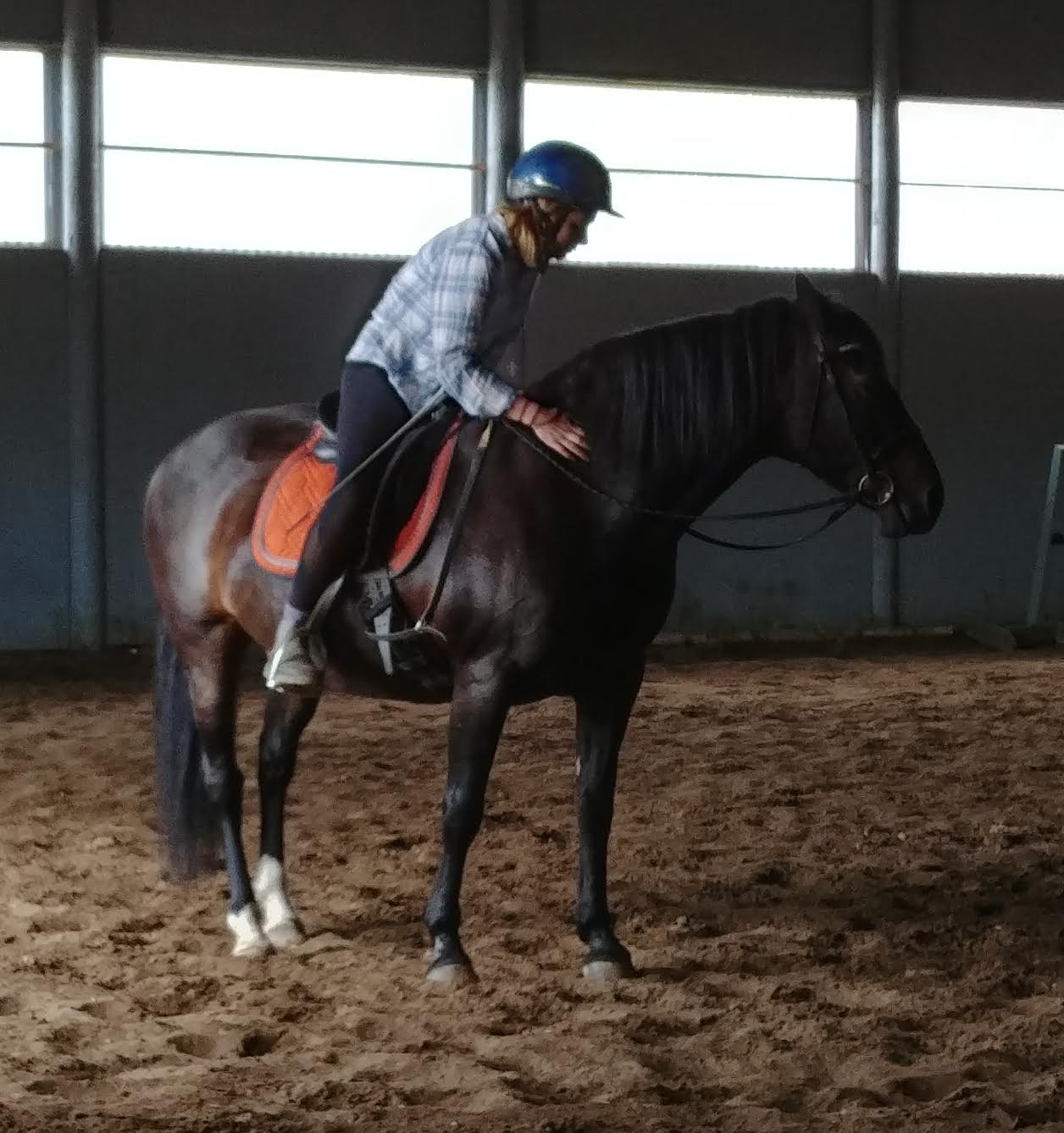 stroking to reward
 relaxed, mellow
 on high alert but without tension. Look at the eyes. She is looking at the neighbour's horses.
more information
TRTmethod.com. Tristan Tucker. on YouTube also
"Unleashing Harmony: The Man Who Dances With Horses" on Slice Wild on YouTube. (Frederik Pignon
Spanish Hofreitschule Wein- Lipizzanergestut Piber. www.srs.at


