Saturday, 25 September 2021

Four things You Can Do to Make Handling Your Horse Easier

 Horses are not born trained.  They are born to eat, watch out for danger, and have babies.

Humans are generally not interested in watching their horse eat, have babies or have their horse run from danger.  Humans want horses to ride or drive or obey signals, as seen in liberty work.  They use horses to do many things.  The horse usually doesn't have much say in what happens in human/horse interactions.


Dakota, a wild horse in captivity

The change of the population from being farm-raised to living in town makes a huge difference in how the person may handle a horse.  Farm-raised people have experience with animals.  They know that animals have a different agenda than people.  Farm people also know that animals can really hurt a human.  Either deliberately or accidentally.


Town people have watched TV, learned about animals, and maybe had a dog or cat while growing up.  Television leaves out unpleasant things or anthropomorphizes animals.  Thank you, Walt Disney.  

Horses are big. They are strong.  They have a particular way of thinking because they are prey.  This means alertness and the ability to move fast from danger is essential for survival.  Even though the horse has been domesticated for a few hundred years.  Breeders have been bred for specific characteristics.  Some are not conducive to being calm, sensible, etc. etc. Compare photos of wild horses to domestic horses, and you will see.  In the wild, being flighty is not good because the horse will use up too many calories.  Calories lost in winter can make the difference between survival or not.  A horse running from fear may not watch where she is going and could get hurt, making the horse vulnerable to a predator.  It is easier to hunt/kill an injured horse or youngster than a healthy horse.

So, what can a person do to make handling their horse safer?

1.  When working in the field or paddock, ask the horse to move.  

Do not walk around the horse.  Move the horse out of your way.  


2.  Tie your horse and leave it for an hour to 3 hours.  Your horse can eat hay. Ignore the pawing. Do not say anything. Ignore the pulling and dancing around. When your horse stands still, then you can say something.  It is best to find something to do while letting the horse learn to stand quietly.

Tie to something solid with a halter and rope that will not break. have about 3' slack. Not enough, the horse can reach the ground.  (put a leg over the rope). At wither height at least. Not lower.  Your horse will have to stand quietly at some point.  Standing quietly in the trailer is best learned by being tied to a post first.


3. Lead your horse on a slack lead.  

The head is in front; you are just in front of the shoulder. This is a safe place to be. Don't choke your horse with a death grip.  Use a rope halter if your horse tends to go where she wants.  If a rope halter doesn't work, you have taught your horse to pull through and to ignore you.  Not a good thing. 


4.  No, it is not an option.  

If your request is reasonable, your horse should do it.  Standing for the farrier is reasonable.  Allowing the vet to work is valid.  (temperature, heart rate, teeth check, touching a body part etc.).  It can take some time to convince the horse to go, but in the end, the horse goes.  Otherwise, don't ask if no is an option.


5.  Keep your horse in a herd, with room to run. The herd discipline will make handling your horse easy. Do not accept having your horse repeatedly chase another horse or be chased.  That is not nice.  


more information

TRTmethod.com. Tristan Tucker. on YouTube also

"Unleashing Harmony:The Man Who Dances With Horses" on Slice Wild on YouTube. (Frederik Pignon)


Raising your horses back: An Easy Way

 Getting your horse's back to rise/round-up is a dream many riders have.  It feels so good when you feel it.  Here are some simple easy to do on your own methods.


I owned (and bred) a long backed horse.  She had a 9 canter!!  Wonderful to sit when I was fit.  When I was fit because  her stride was so long.  My back had to keep moving forward.  Because Gracie had a long back she was trained with her head low (about wither level) so that she would not drop her back. This is not only for long backed horses by the way, but for all horses.  Head up is only for showing. (in dressage).  If your horse is naturally on the forehand (very low head carriage) it will help if the horse is ridden with a higher head carriage.  Ride according to your horse's conformation.  

Living outside in hilly pastures helped her move with her back up.  It is the easiest way to get a horse moving from behind (and therefore the back raised).  Horses raised on the hilly ground will learn to step up and underneath themselves as they move around the pasture.  Give them a year or 6 months.  Watch when the horse trots up and down the hills.  The hindleg will step more forward, the hindquarter muscles will flex.  The head and neck will be down as well.  Not the exaggerated to the knees down, but around wither level. Lower if the horses are on a steep hill (then most likely will be walking).  

Stepping forward and underneath their body is what raised the back.  Look for a hindleg being the first to step forward.  

Watch your horse move around the pasture.  (this is why you want your horse in a pasture for hours and hours and not in a paddock that is only an acre big or smaller.  Your horse won't move as much).  Which leg steps forward first from a halt?  Front or hind? (thank you, Alex Wortmann, I remember this lesson).  Which leg stops first? Front or hind? It should be the hindleg.

When your horse suddenly stops which is more comfortable? stopping on front legs or hindlegs.  This is why when your horse stops suddenly you either sit comfortably or get tossed around.


Physio for the Sore backed horse


 October 2020


Frankie's Sore Back and Therapy

Used for vaulting mostly at a walk, with some trotting by students that are supple and have progressed from Ziva and Miss July


Diagnosed with possible kissing spines

To receive Previcoxx once a day for 60 days

Purchased October 2019 halter broke only


Indications of trouble

misstepping at walk on any leg, which gradually became worse over time

cannot cross hindleg in front of over and past the leg in turn on forehand, working

not stretching down at trot or walk.  Poll is lower than at trot or canter

refusing to leave stall to work

no flinching at touch to her back

sore in the back where a rider would sit 

Muscles of back raised on each side

Muscles on croup are developed (not through in the back)

Does not over track at walk

canter hindleg does not come under rider's seat

naturally high headed

back hollow

not moving from behind

difficulty stepping over cavalletti on lowest


Physio Programme

30 minutes minimum of lungeing at walk, trot, some canter (as her canter needs to slow and balance better) per day

walking forward at walk, working from behind:  wearing a neck stretcher to encourage her to lower her heard.  Neck stretcher does not hold her head down but to make it incomfortable to be inverted. 

slow trotting to encourage her to lower her head.  Able to drop to knee level for 2/3 strides after 1 week of work

leaving stall willingly

not standing still to have tack adjusted (feeling better about moving?)

She will have trot over cavalletti on lowest setting to see how steps over (in stride, not hitting the cavalletti with a toe)

To improve canter will lunge over jumps (cavalletti set at highest point). Be sure not to jerk her when she lands or shortly after.  Punishing the horse for doing what you want is counter productive.


Diary

Oct 29 Judy Hyde came out to work on her.  Hips locked, sacrum tight, withers locked which would cause nerve pain/stumbling, 

Frankie December 2019 training to be ridden


Today (Oct 30) cantered disunited which she has done in many months. Did not change on her own so brought back to trot.  would also do canter to halt transitions when asked for canter/trot transition.  Able to do halt trot transition


3 weeks after diagnosis

2 days off.  Walking through the snow (about 8" on the ground"

Snow is an excellent exercise tool.

able to step over the cavalletti at walk and trot without hitting sometimes. Reaching to step over rather than taking a stutter-step (was seen at a walk and trot previous week)

Bent to inside on the circle on both reins.  

working from behind  Hindlegs first to stop and to move off.  

The left hind swings out and landing outside of the front hoof on a circle.

Able to cross in front of the hind leg when doing a turn on the forehand

Standing quietly to be tacked and untacked.

Able to catch easy

 A wool blanket was used for warming her muscles before working.  Kept on during work so her back muscles don't chill.  Wool is used because it is warm even when wet

counter bending on a circle is shown by lunger/person inside the circle able to see the outside jawbone


Photos from fall 2019 showing posture


good stretch: he is able to do this on the lunge for 2/3 strides at walk and trot after 2 weeks


Note lower neck muscling

note muscling on her croup


has soft lumps on left front knee

Update

September 2021

X rays in August showed lots of arthritis in her knee.  In the front and behind in the joint.  Dr. Green speculates she was in a bad wreck.  She had arthritis in an area horses don't get arthritis in the knee (behind the knee joint).  She also has a big scar at the top of her leg.  When we got her she would not let people touch her hindquarters. She kicked.  Did not stand quietly.  


Frankie has been excellent in lessons. Very kind. Attentive to the rider/vaulter.  Sensible.  She is young (11 years old) so we decided to inject her knee.  She will be mostly pain-free for another year or so.  

It is such a shame.  She improves every lesson it seems.  Her mind is so good.  Her body is developing 
very nicely.  


.  

An easy way to load a horse for the first time without help

 I learned how to load my horses into a trailer because my "helper" always rushed the horse.  The rush caused anxiety in the horse which tarnished their view of trailering forever.  The first experience is the most important.  Rushing doesn't help.

Here are the steps I take when loading my horses for the first time or subsequent times.  

1.  Park the trailer on level ground.  You don't want a step-up trailer with the back higher than the front.  With a ramp, you want the ramp level.  A moving ramp doesn't inspire confidence.  Would you go up something that sagged under your weight?


2.  Move the centre partition over.  tie it to one side.  No, you don't have to open the escape door at the front.

Slant load trailers should have the partitions locked to the side.


3.  Bring the horse towards the trailer in a straight line.  Do. not come at an angle.  It gives the horse an option to not go forward.

Where the horse stops to look at the trailer is where you start training.  Hopefully, it won't be 50 feet away (I have had that).  Stop the horse, reward. food works.  Food the horse prefers is better.  I use alfalfa pellets or cubes, but as a friend said, her horse won't piaffe for alfalfa.  But they will for carrots or apple bits.  Keep the treats small.  1" by 1".  frequency is important.  Waiting for the horse to chew and swallow a carrot takes forever.

Ask for 1 step towards the trailer.  The horse is facing the trailer, not allowed to look away.  Focus on the job on hand.  Reward the one step.  Repeat until you are at the trailer.  

If the horse is backing away or thinking of running away, circle away.  You have gone too fast to get to this point.

4. At the trailer allow the horse to sniff.  Hopefully, the trailer will have Eau du Cheval.  If not add manure to the trailer.  Eau du sheep won't help. or goat or pig. Reward the horse for sniffing.

5. Ask for 1 step.  Reward.  When asking for the step forward release the pressure on the lead rope. Slack but not lots of slack as you want the horse to face the trailer. Take your time.

6. Ask for another step. Stop reward. If the horse offers more steps go for it.

7. Ask for another step.  Stop reward.  If the horse offers more steps go for it.

8. If your horse decides that has been enough and wants to leave you can give the unload command. I sue "unload" and circle around and start over again.  If you can stop the backward motion (ideal), stop it.  

9.  Once you have the horse into the trailer, but not all the way in:  do NOT ask faster.  Continue the ask, reward when the horse responds.

10.  Do up the bum bar if all went smoothly and your horse has hauled previously with a good experience.  If not unload the horse.  I pull on the tail and say "unload".  Repeat the loading process again.  You should be able to do the bum bar up with a horse new to loading this first session.  If the horse is young wait until the next time you have a loading session.  The entire session should take 5 minutes.  If your horse has manners, accepts being told what to do, trusts you, and you have not rushed the process.  Quit now.  If time is important you can repeat in an hour or so. Or the next day or the day after.


The secret is I use a rope looped through the tie ring or chest bar at the front of the trailer. I use a stick or dressage whip that is about 3' long to tap the horse.  Teach the horse to respond to the tap on the side and croup before you use the trailer.  Teach your horse to step forward to a pull on the halter before you have the trailer ready for loading.  Most horses that are trained will respond to the touches and pull on the lead rope.  The release of the pull on the halter is the reward.  Stop pulling when the horse steps, or even thinks of stepping.  If you cannot do this don't even think of loading your horse into a trailer or anything.  

Tap for 1 step, or pull lightly on the lead rope.  release only when the horse thinks or does steps forward.  This is most important. If you do not release your horse will resist.  

Gather up the rope as your horse steps forward.  If your horse has an issue with the rope touching legs then stop the loading and train your horse to accept being touched on the legs.

Once your horse is in the trailer, do up the bum bar. take off the long rope.  You can use the long rope for unloading if your horse zips off.  You will still have the horse in "control".  Don't slow the horse down if rushing off the trailer.  You will only cause a panic attack.

To unload. Pull on the tail and say "unload". Reward for each step back.  If your horse will not unload, then wait. Pushing, pounding etc won't get your horse off any faster.  reward the horse once off the trailer.  

That's it.  It won't matter if you train in a straight load or angle haul.  Your horse will load willingly into either trailer.

You can use just the stick and throw the lead line over the neck of the horse. Have a second lead line for control. 

If you train with the long rope, you will have to use it until your horse loads without it.  It might take a while even if you haul weekly.  The good news is that your horse will step into the trailer as soon as you put it on.


Rearing, backing up, kicking, refusing:  do happen.  Just wait. the horse will settle down.  Reward what you want, ignore what you don't want.  If your horse has a long history or even a short one of not doing as asked the sessions will increase and be more dramatic. That is a handler issue.  


Benefits of teaching a horse to load this way

It is fast.

It is without drama.

The horse doesn't object and will be more willing the next session.

You don't need a helper.  If you do have a helper that person can offer the food reward when the horse is in the trailer through the escape door.

Safe. Walking in with the horse can leave you injured or bruised.  Maybe not this horse or this time.  being in an enclosed, small space with an unhappy horse is not fun.


Previous Skills the horse needs prior to Loading in Trailer Session

A.  Touch Aids

1. Stepping forward to a pull on the halter. No vocal command.

2. Move when touched at the side and croup. No vocal command.

3. Move sideways when touched on the hindquarter for doing up the partition.

4. Teach the horse to do one step.  It makes doing the bum are up easier. The command is "one step"


B.  Voice Aids for Loading

1. Good boy/girl, or a cluck when the horse responds.

2. Load up 

3. One step

4. Unload


Reward

1. Food in the beginning sessions.  Food the horse particularly likes eg carrots for a faster response.

3. Release the pressure on the lead rope

4. Stop tapping.  (this means you keep tapping until the horse moves.  You can change the frequency or the intensity of the taps to elicit a response.  You might want to go back and school the horse on responding to taps.)

5. Scatches at the withers, tail head.


Warning

1. Do not stand directly in front or behind the horse. Always stand to one side.  

2. It is best not to have a helper.  


When driving off

Wait until the horse has been in the trailer for a few or 5 minutes.  Finish loading up with whatever you are bringing once the horse is loaded.  Do up the bum bar.  Wait for a few minutes then close the door.

When you get where you are going. Let the horse stand for as long as possible before opening the back door.  And again before unloading.  It is safer if your horse waits in the trailer than tied to the outside or worse holding the horse.  All the time.  Every time.  Guess how horses that dance around in the trailer were trained to do this?


If your horse kicks, scrambles, doesn't want to load.  Change your driving.  You are too rough.  Put sand on the mats first, then sawdust/shavings on top.  Every time you haul.

Dry out under the mats after every trip.  Replacing floorboards is not fun or cheap.


Wednesday, 7 April 2021

Why I Use Vaulting for Riding Lessons


 Gus, the Halflinger, in a vaulting lesson.


This is a vaulting student's first ride in a saddle.  She learned to hold the reins, mover her hands with the nod of the horse's head, turn, two-point, and start rising at the trot.  Be impressed.


Why would you want to vault when you actually want to sit in a saddle and ride a horse?  Vaulting is a faster method to learning to ride well.  Riding well involves having a good seat.  A good seat is moving with the horse as in no bouncing, hanging on, tension, stiffness, lack of balance.  The person is comfortable being on the horse.  Learning is fun.  The student does only what they are comfortable with.   Lessons are progressive and very enjoyable for the onlooker as well as the student.  Progress is speedy.  Even within a lesson, what a student is comfortable with at the beginning and end can be dramatic.

Miss July. Yes, we vault in the winter.  Miss July's ears show she is paying attention to what is happening on her back.  


Students as young as 3 years old will benefit from vaulting. At this age, the baby is with an older, more experienced vaulter.  Learning is intrinsic.  An example is a baby, 3 years old, who sat with her mother for summer, once a week.  Several years later, the baby loves horses and is not afraid.  The primary purpose of the lessons was to expose the baby to horses so she would not be frightened. (her father is so was a concern of her mother that she did not become afraid. Success!

Vaulting is considered the safest of equestrian sports. The vaulter develops core strength, the ability to feel the horse (an essential part of riding).  Part of the lesson is jumping off the moving horse.  The vaulter learns to fall more safely (no holding on, no arms out to stop the fall).   Yes, falling off is part of riding.  Sometimes getting hurt is part of the package.  But, if limiting the damage from falls will help the rider, then why not?  

The Greeks had their boys and men vaulting as part of their training.  Then the Romans vaulted, and the Europeans took it up until finally vaulting came to the New World.

She vaulted before riding Alex.  Alex is not an easy horse to ride because of anxiety (she was started by an abusive trainer) and her giant stride.  Alex did not want to be a vaulting horse.


Europeans had vaulted for decades before vaulting came to Canada.  Notice how Europeans ride:  their seat stays in the saddle, no flopping legs or hands, head.  Could it be because the rider vaulted first or was put on the lunge?   Peer teaching also helps during lessons for encouraging students to try new moves.  Not all learning is directly from the instructor but by fellow students.  It is good that students learn from each other and. not directed by an adult.  Students are encouraged to think for themselves.  They are not micromanaged with every move required, but students in vaulting must think about what they are doing and how to achieve what they are attempting.  Everyone is different.  The moving horse changes a lot.

A rider with injuries from falls is affected mentally as well as physically.  It could actually limit the rider's ability to ride to her potential.  Fear creates tension which inhibits riding well.  


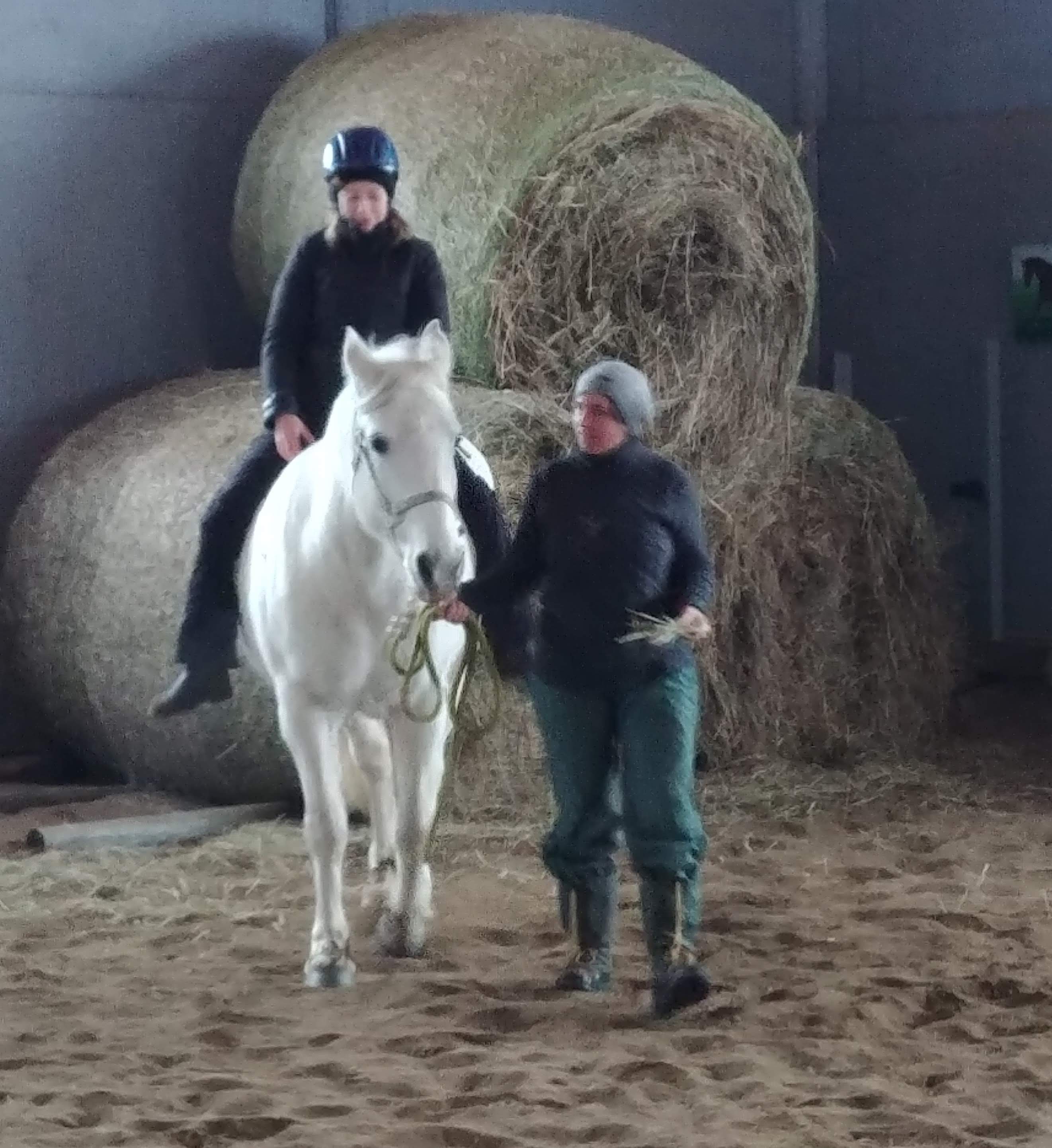
Frankie learning to become a saddle horse.  She is now a wonderful vaulting horse.  


Lying on the horse lengthwise. No helmet as the vaulter can jump off at a walk.  Miss July is a beautiful vaulting horse for anyone.  She is an excellent riding horse that everyone enjoys riding.


                                                                     Flag on Gus


The new rider will need to wear stretchy clothes (legging, sweat pants, t-shirt), soft-soled shoes, and a helmet (I have my students wear a helmet initially.  That is my personal preference.  Riding boots are necessary for working around the horse.  Yes, vaulters are expected to groom, tack up, and generally look after the horse before and after a lesson.  Stable management includes cleaning the stall, sweeping the floor, and manure picks up in the arena.  Good skills to learn.  

                                                    Cautiously standing on Gus.


Lessons begin with looking after the horse:  grooming, tacking up, warming up, setting out equipment and finish with looking after the horse (cleaning the barn, putting away the equipment).  In between is the actual time in the arena:  warm-up, ground exercises, barrel work, and horse and repeat with groundwork, barrel and again on the horse.  The lessons are in sets.

Standing on Gus, minutes later.


Emphasis is put on the welfare of the horse.  It is not any horse that can become a vaulting horse.  Temperament, smooth moving, tolerance, and sound are all essential attributes for a vaulting horse.  A horse can be used for beginners and only walk and trot in lessons and competitions.  Another horse will be used for students that are cantering.  It takes a particular horse to do either job.  Rarely would the horse be used for a walk, trot, and canter.   As well as vaulting the horse should be ridden in dressage type work, jumped and trail ridden.  Loose jumping, time out in a field also will help develop the horse's muscles equally.    Cross-training is vital for keeping the vaulting horse sound and mentally happy.                                                          

       Stuart learning to become a vaulting horse.  Didn't become one. 


Some horses wear sidereins to help keep the horse in a consistent position.  This horse will have to have time off the sidereins to stretch every 15 minutes.  Which sidereins the horse uses is horse dependent. 


        Shoulder stand at a halt on Miss July for fun.


The vaulter learns to move with the horse.  Moving with the horse is one of the essential lessons a rider needs.  If the rider does not move with her horse, she will slow the horse; she will constantly use her legs and interfere with the horse's balance.  Soundness can become an issue for the horse as well.  So, moving with the horse from the small of the back is essential.  This learning is intuitive.  No instruction is required.  

The rider learns the leg sequences of the horse's gaits.  The walk is 4 beats, the trot is 2 beats, and the canter is 3 beats.  The learning is intuitive.  Learning rising trot and correct leg on the canter is easy when the vaulter sits in a saddle.  A balanced seat (ear, shoulder, elbow, hip, heel alignment) is part of vaulting (basic seat it is called).

Fun on Miss July at a walk (pre-covid) Changing places on the horse


The rider develops confidence in her ability to stay on the horse and will remain on easier.  She will also, without thinking, fall without causing harm to herself (let go and fly rather than gripping and attempting to stay on, which is when injuries occur.).  The confidence changes the rider's mind.  In a saddle, even when started on a lunge line, this process will take years to attain.  Some riders never do get this far, no matter how many trails ridden or years.

The rider will be balanced and not require reins to stay on.  This is a massive leap in learning to ride and will take years to learn.  Balance without holding on with hands or legs is when riding becomes fun. It is called having an "independent seat".

Learning to sit the trot is a long process that can only be understood by sitting the trot.  Learning while vaulting shortens the learning curve significantly (by years).  Lunge lessons help, but most instructors do not teach lunge lessons.  It again takes a particular horse.  One that is reliable, sensible, sound, sane, etc. Sitting the trot is a skill that can only be learned by sitting the trot.  In vaulting, trotting and sitting is part of the lesson.  Again, it is up to the vaulter how much trotting she does.  Trotting is not easy.

       Diamond learning to lunge, in a few years, will be a vaulting horse, maybe.


What vaulters do in their lesson depends on the individual.  Ground exercises help build strength, teach the muscles what to do.  It is easier to perform on the ground than on the barrel usually.  The barrel is more manageable than on the horse because no matter how still the horse is standing, there is still some movement (breathing, for example). Spotters are used to helping the vaulter, just in case.  Once the vaulter is ready, the horse is lead.  Then the horse is lunged at a walk.  Each step is small but essential. Some vaulters never progress to the next step, but that is okay.  No pressure.  

There is a progression for everything.  Once a walk is comfortable, then trot is introduced, then canter.  Cantering is a long time coming, mainly because of me. (Emma, a student, told me this).  I have been told that cantering is easier than trotting.  I learned to ride so long ago I have forgotten this.

Some exercises,  for example, handstands, take more strength than others.  Not all people will be able to do handstands.  That is fine.  


The barrel is the next step from doing an exercise on the ground.  Once the vaulter can do a movement on the barrel mounted on the horse is next.  Beginning at the halt, the walk, trot, and finally at a canter.  Some people will never do what others can do.  That is not important.  The most crucial point is the progress the vaulter is making.  Not what other people are doing.

Even in the first lesson, spectators can see learning taking place.  Sometimes the vaulter is nervous and wants someone to ride with her.  By the third set, the vaulter is not only riding alone but waving at mom. In one lesson.  Amazing.  

Riding better is a lifelong process.  Vaulting speeds up the process.  The welfare of the horse is essential and repeatedly stressed throughout lessons.  Horses generously allow us to vault, ride and drive them.  Riding a horse is relaxing; it is pleasant, even at a walk.


Riding Ziva outside.  Ziva teaches a lot of younger riders.  She is my top vaulting horse.  Variety of work is vital for working lesson horses.


Another video from the first lesson


Thank you, Shannon, Maya, and Auntie for sharing these videos that illustrate so well why I start people vaulting on their first lessons. 

What Dandelions Tell Us


Dandelions:  An Indicator Plant 

Dandelions indicate how your soil is doing.  Keep them.  They will improve your soil for you.  These are great plants for the soil and insects. The leaves and roots can be eaten by animals and birds (the presenter told about geese fighting over a dandelion root one of the flocks had dug up).  They are very nutritious.  People can eat dandelion leaves in salads ( the young leaves are tastier, I have heard).  The leaves are loaded with vitamins and minerals, including the antioxidant beta carotene.  Dandelion roots are high in inulin, a soluble fibre that acts as a probiotic, feeding good gut bacteria.


What dandelions indicate:

  1. Compacted soil
  2. Deficient in calcium
  3. Acidic soil


What makes dandelions valuable?

1.  Dandelions fix soil deficiencies.   

Compacted soil is repaired by growing dandelions.  The big root loosens the soil by growing.  Roots can survive many years, even when cut.  Roots can go as deep as fifteen feet into the ground.

Soil deficient in calcium grows dandelions.  The dandelion root brings up calcium deep in the ground.  Mowing kills the calcium-rich leaves, which puts calcium within reach of the grassroots.

Acidic soil is changed to neutral with the growth of dandelions.

2.  Dandelions are one of the first plants to grow in the spring.  The is a benefit to insects.  The early insects will prevent undesirable insects from inhabiting the pasture/lawn.  Bees go to dandelion flowers.  In the spring, dandelions help bees survive.

3. Dandelion leaves are one of the best natural sources of potassium, with 218 mg per cup of raw greens. They are also high in vitamins, A, C and K, as well as calcium, iron and magnesium.


4. Wild animals such as grouse, partridge, pheasant, quail, and wild turkey will enjoy the seed heads. Songbirds, such as blackbirds, goldfinches, sparrows, siskins, and towhees eat the seeds.


When the soil is in good condition, the dandelions will disappear.  No herbicide.  No pulling.  


Dandelion leaves have fairly good forage quality and their presence in the forage, especially when harvested as silage, does not significantly reduce the feeding value of the crop.  Dandelions are also good forage for grazing animals.


Dandelions are an indicator in over-grazed pastures.


The name of  Common Dandelion, Taraxacum officinale, translates to dent-de-lion in French, meaning “the lion's tooth.” It is also known as Piss-in-bed, wet-a-bed, blowball, puffball, fortune teller, doonheadclock, tell-time, clock flower, bitterwort, yellow gowan, swine snort, Irish daisy, priest's crown, cankerwort etc. 


Dandelions For Humans

The bitterness of dandelion increases stomach acid, improving digestion. (Contrary to popular belief, acid reflux is often due to inadequate stomach acid.) increasing the flow of bile from the gallbladder into the duodenum. It also acts as a choleretic, increasing bile production.


You can try some dandelion tea before meals, or steeping some chopped greens in white wine to accompany your meal or add the greens to your salad.

The inulin of dandelion roots helps to bulk up stool.  Potassium and magnesium in the leaves may help relieve bloating and constipation.


Use dandelion flowers to lighten freckles and age spots, relieve sunburn and tighten pores. In, Susun Weed suggests covering freshly picked dandelion blossoms in boiling water. Cover your container and let steep for one hour. Strain and reserve liquid.


Apply the sap from the flower stalk directly to warts, calluses corns and rough skin. Rub in and repeat as needed.


Is dandelion good for diabetes?

Initial studies say “yes”, dandelion may be helpful for regulating the blood sugar of type 2 diabetics. Volunteers in a 2016 study who consumed 5 g of dandelion root and leaf powder for nine days significantly reduced their fasting blood glucose levels

This may be because dandelion contains a source of levulin, which allows the liver to convert fructose in glycogen without insulin secretion. (From 


Dandelion has a long history of use as a liver tonic. Antioxidant effect – reducing oxidative stress, promoting the regression of fibrosis, improvement in fatty liver disease symptoms, anticancer


Dandelion is also known for its diuretic effect, clearing excess water weight without depleting potassium. 

Infuse dandelion flowers in oil to make an ointment for sore muscles or dry skin. 


        Method

    Gather enough blossoms to fill a jar

    Cover with olive oil. 

    Infuse for a week or two and then strain.


Dandelions may cause allergic reactions or contact dermatitis in some individuals. 


References

The Permaculture Orchard, on Youtube, accessed April 2021 


Neverman, L., Benefits of DANDELION PLUS HOW TO USE GREENS, SEEDS, ROOTS & FLOWERS, MARCH 16, 2019;  https://commonsensehome.com/dandelion/ Accessed April 2021


Agriculture dandelionhttps://www.gov.mb.ca/agriculture/crops/weeds/print,dandelion.html


Sanchez, A., Ten Things You Might Not Know About, Summer, 2007; https://www.mofga.org/resources/weeds/ten-things-you-might-not-know-about-dandelions/


For more information


Making money with dandelions, FARM SHOW Magazine, 2007 - Volume 31, Issue 6, Page 8

https://www.farmshow.com/a_article.php?aid=20546Growing Dandelions For Dollars


 Healing Wise


The Wild Wisdom of Weeds: 13 Essential Plants for Human Survival.)


Saturday, 2 May 2020

Why would I reward a horse for doing what I asked?

People who know me through horses are most likely wondering about this title.  I reward often and use various methods.  I like to see good results. Now.  By rewarding often I get good results quicker.  For years I rode a horse that was tense, pulled, blew up and was basically awful to ride.  I took monthly clinics and tried my best to do as told.  My lessons were recorded on a handheld recorder so I could review my lessons.  For years.  I did this.  It seemed to me that I was still at the beginning.  He was tense (I realize now), ran through the bit, didn't respond to my leg aids, was slow to respond to any aids and was basically awful to ride.

At 16 years of age, after being ridden for 12 years I quit riding him.  I had a nicer horse.  I had also changed riding instructors.  Thank goodness.  It wasn't that she was tough but that she didn't give me the information I needed in order to ride my horse better so that he didn't pull (actually it was me holding him so he pulled) and run through the bit.  My new instructor "rode the horse while I sat on my horse".  It was amazing.  Suddenly I wasn't being told to lower my hands, to shorten my reins but actually almost the opposite.  My back is long, my arms normal length so naturally I couldn't ride with my hands just above the withers.  As a female it was also impossible for me to ride with my hands 6 inches apart (for a male that is in front of the hips).  The longer rein stopped the horse from running through the bit.  It allowed her to drop her neck and reach for the bit.

Martina's lessons were simple.  No complicated movements to try to do.  Just 20 metre circle, go large, turn.  However, one had to feel what the horse was doing and ask at the correct time.  Much easier to ride.  Either the horse responded or not.  No upcoming turns or inclines to worry about.  Correction of the horse and rider were consistent.  Focus on the rider enabled the horse to relax and move better.

I still remember my first lesson.  flex to the inside, inside leg, half halt with outside rein.  And suddenly the horse was bent to the inside, paying attention, easier to ride, and so on and so on.  this lesson was the night before Martina was flying to Germany for the winter.  It took me almost all winter to learn when and where to use this (everywhere).

Circles were easy doing it Martina's way.  Turn you upper body the degree you want the horse to turn.   More for 10 metre circles less for 20 metre circles.  No half halts.  No bending to the inside.  Look to where going and turn your upper body.  Piece of cake.

Another lesson I remember was also just before going off to Germany was to correct my pulling/heavy hands.  It was loosen the reins to almost the bucket. (almost 12" from the buckle).  Spring had a  beautiful neck so over bent to loosen the contact of my hands.  I was to do this until Martina returned.  Three months on a loose rein.  It wasn't a hardship.  I could walk, trot, canter, turn etc etc.  I just could not shorten my reins.  Oh my goodness the difference this time made.  Spring reached for the contact and never over bent after this.  She was a delight to ride.  Nice before but a delight now.

In addition to having simpler easy to replicate lessons I was learning to reward my horse.  Uberstretchen is a reward for the horse. One rein or both reins it is a reward.  It is also a test to see if your horse is on the outside rein.  If not when you give with the inside rein the horse will counter bend to the outside.

Feeding after work is a reward for horses.  The last thing they remember of you is eating.  This means the next day when you go to get your horse the horse comes to you.  That is not a hardship.

Treats during work help the horse understand that this is what is wanted.  It is especially important to reward the horse when learning something new.  How else will the horse know?

Western trainers are posting a meme "what time is it?" Rider says: 4pm.  Trainer says "what time is it?"  Rider says: afternoon?   Trainer says "what time is it?" Rider says:  4 o'clock to illustrate that if you keep asking the same question the horse doesn't understand what the correct answer is unless you reward you horse.


Types of Rewards for the Horse

1.  Food
big chunks for nervous, anxious horses
none for the horse that wants to crawl into your pocket looking for more
If your horse will not accept food your horse is quite upset.  A sign you should wait and not do anything demanding of your horse.

2.  Scratches
Scientists have discovered an horse's heart rate lowers by 10 beats a minute with a wither scratch

3. Strokes
long strokes along the crest of the neck.
A pat is a hit.  Horses learn not to run after being patted.  I don't know if they learn that the hit is a reward.

4.  Giving with one or both reins
Also known as uberstrechen

5. Stopping what your are doing
Repeat the request 3 times then that is it.
This is why school horses are saints.  Humans need more than 3 repetitions to figure things out.
Repetition is punishment.  Remember writing lines in school?

6. Asking for the opposite of what you are doing
extended or medium trot after collection.  A reward and also a way of maintaining the forward movement.

7. Stop
Take a breather. Watch the birds.

8. Loose reins
At walk, trot or canter it is a reward.

9. 2 point on long or loose reins

10.  Food at the end of the work session in the barn or tacking up area if no stall is a big reward for the horse.


Signs of Relaxation in the Horse

1. Swinging tail= swinging back
the next is down and the tail swings back and forth
Tension is a clamped, or bobbing tail or kinked tail.  Extreme tension is when the tail is held vertical (called having the "wind up its tail")

2. flopping crest:  flops on turns to the inside

3. Neck is down about wither level or  just above.  Poll is the highest point.
In addition to the neck being convex the bottom muscle is flapping (it should be tiny, as well)
Inverted necks have the head held high,  The bottom muscle on the neck bulges forward. It looks like the horse is pulling itself along.  Steps will be long but hurried.

4.  The horse snorts and blows his nose.
The mucus in the nostrils tickle the horse's nose so he blows his nose.

5. The poll is soft.  The Altas bone allows the horse to flex and to bend to the inside or outside.  Tension in the poll is often associated with being head shy or unwilling to lower the head.

6. The horse takes long, slow steps in his rhythm.

7. The horse may have "lipstick" on his lips from chewing the bit.  Treats help the horse chew the bit.
Huge amounts of slobber as not a sign of relaxation but of tension.
The lips are relaxed not clenched.

8. The ears move.  Or are held sideways and flop a bit.
Pricked ears that rarely move are not a good sign.  The horse is not paying attention to you.

9.  The horse responds to you in a relaxed manner.  The breathing is deep and regular.

10.  The eyes are bright, wide without any white showing, or worry wrinkles.  The horse is watching where going and not looking to the sides in case of trouble.


Signs of Tension in the Horse

1.  Hard to catch
Hard to catch because the horse is afraid of what will happen.

2.  Eyes wide open so the white shows.  This is a bit difficult with a horse that does not have a coloured sclera.  You will know.

3.  Worry wrinkles above the eyes or around the mouth.
Stroke gently to relax.  Treats help.

4.  Head held up.  Looking at the horizon.  Inverted maybe.  A well developed lower neck muscle is a good indicator that the horse goes around with the head up.  Usually looking for trouble.  Look for the worry wrinkles

5.  Spooky
Some people train their horse to spook by insisting the horse go to whatever the horse is leery of.  The horse will learn well and will repeat the spooking at the same place.
Do you want your ride to be on going to something spooky or to practice something fun?  Stay away from the scary bit.  When the horse is focused on you the horse will go by it without a twinge.
Spooky horses don't trust their rider/handler.  Why?  Why is your horse so reactive?  What happened? Horses will spook.  It is the degree and frequency of the spook that matters.

6.  Won't eat.  Horses are usually willing to eat food they like.  This is very important.  Stop what is happening until the horse will eat.  Reconsider what you have been doing.

7.  Licking lips and chewing are signs of relaxation.  This means the horse was NOT relaxed prior to this.  Not good.  Stop stressing the horse.  When learning something new it is important that the horse is calm.  Horses and people do not learn well when stressed.

8.  Tail is clamps to the horse's body or hangs. A kink is a sign of tension. Not a good sign.

9. Pinched mouth.  As in people it is a sign of tension.  Rubbing the mouth, lips helps to relax. Chewing is good.  Champing is not.  Tongue out. Slobbering.  Mouth open.

10.  Tight muscles.  Not a very good sign.  Muscles should be soft when touched.  Rubbing push/releasing helps.


When to Reward
Immediately after the correct response.
At every correct response until the horse is ready for a different reward.  eg from treats to a scratch or stroke.
Usually by that time the horse is being rewarded for something new.
Food offered for a reason will not result in a horse that mugs you.  Existing is not a good reason.


head is up but not tense


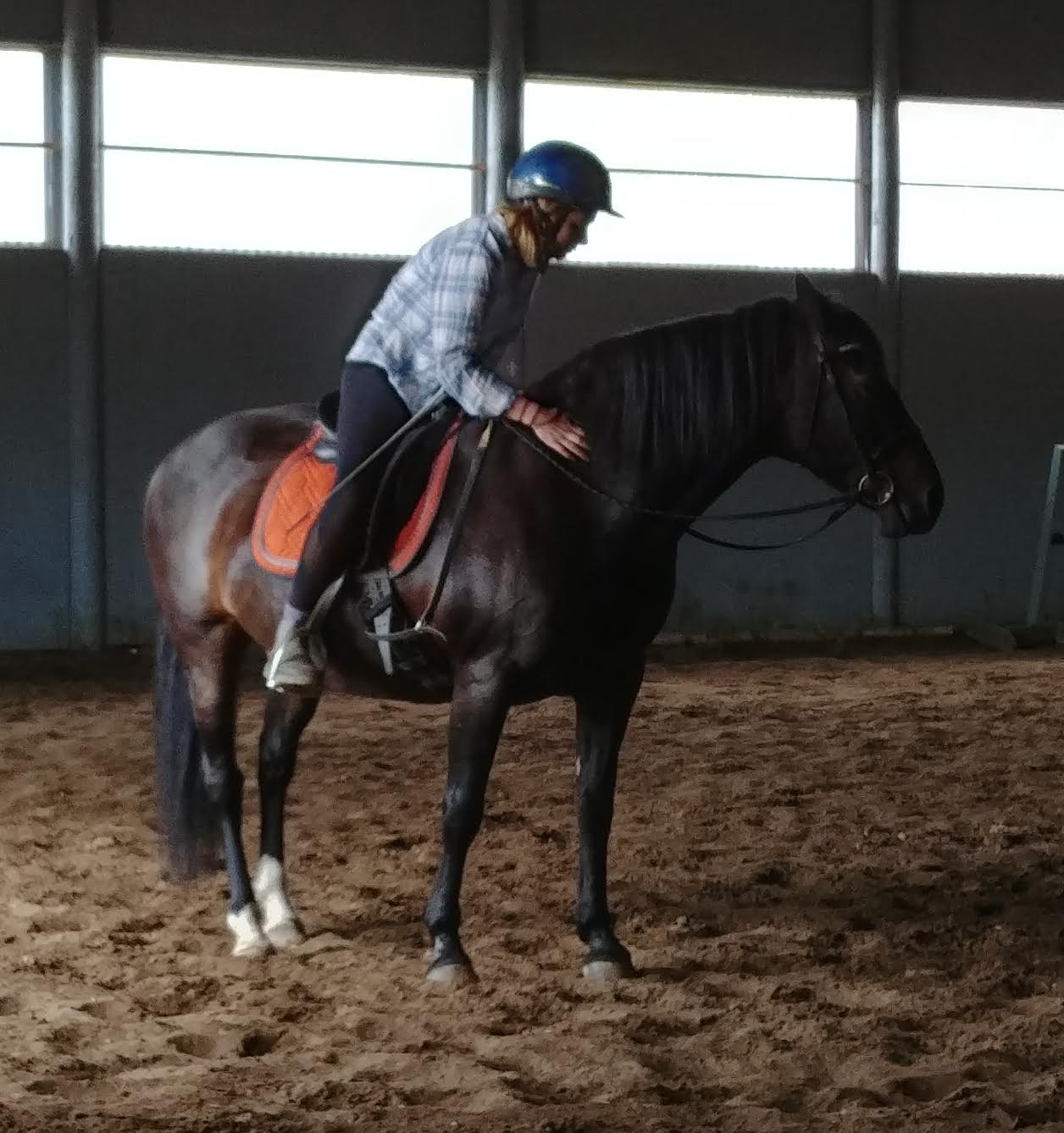
stroking to reward

relaxed, mellow
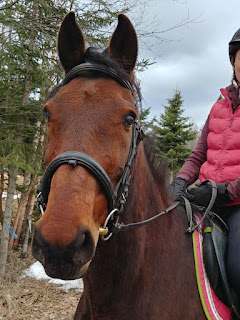
on high alert but without tension.  Look at the eyes.  She is looking at the neighbour's horses.

more information

TRTmethod.com. Tristan Tucker. on YouTube also

"Unleashing Harmony: The Man Who Dances With Horses" on Slice Wild on YouTube. (Frederik Pignon

Spanish Hofreitschule Wein- Lipizzanergestut Piber. www.srs.at